

A record shelf for LPs needs a shelf depth of at least 30 centimeters, preferably 33 to 35 centimeters with a back panel, plus one to two centimeters of space at the top for easy access. With these three dimensions, you can plan a shelf that fits any collection ranging from 100 to well over 900 records, whether you’re just replacing an old, cheap cube shelf or filling an entire wall with vinyl.
Collections are currently growing much faster than many shelves can keep up with. In 2025 , vinyl generated 152 million euros in sales in Germany, an increase of 2.8 percent, and now holds a 44.2 percent share of the physical music market, while total sales of recorded media plummeted by 11.9 percent. In practical terms, this means more records per household—and, quite often, a shelf that was once meant to hold 50 records and is now bursting at the seams.
- A shelf depth of less than 30 centimeters squeezes the sleeves, spines, and protective film against the wall.
- 55 LPs together weigh about 15 kilograms, so a full meter of shelving weighs significantly more.
- Wall mounting is recommended if the floor is uneven and the shelf height is 1.80 meters or higher, or if there are small children in the home and the shelf height is 1.20 meters or higher.
- Modular cube shelving systems can be easily expanded later to the sides or upward, without having to buy an entirely new set.
How deep does a record shelf need to be for LPs?
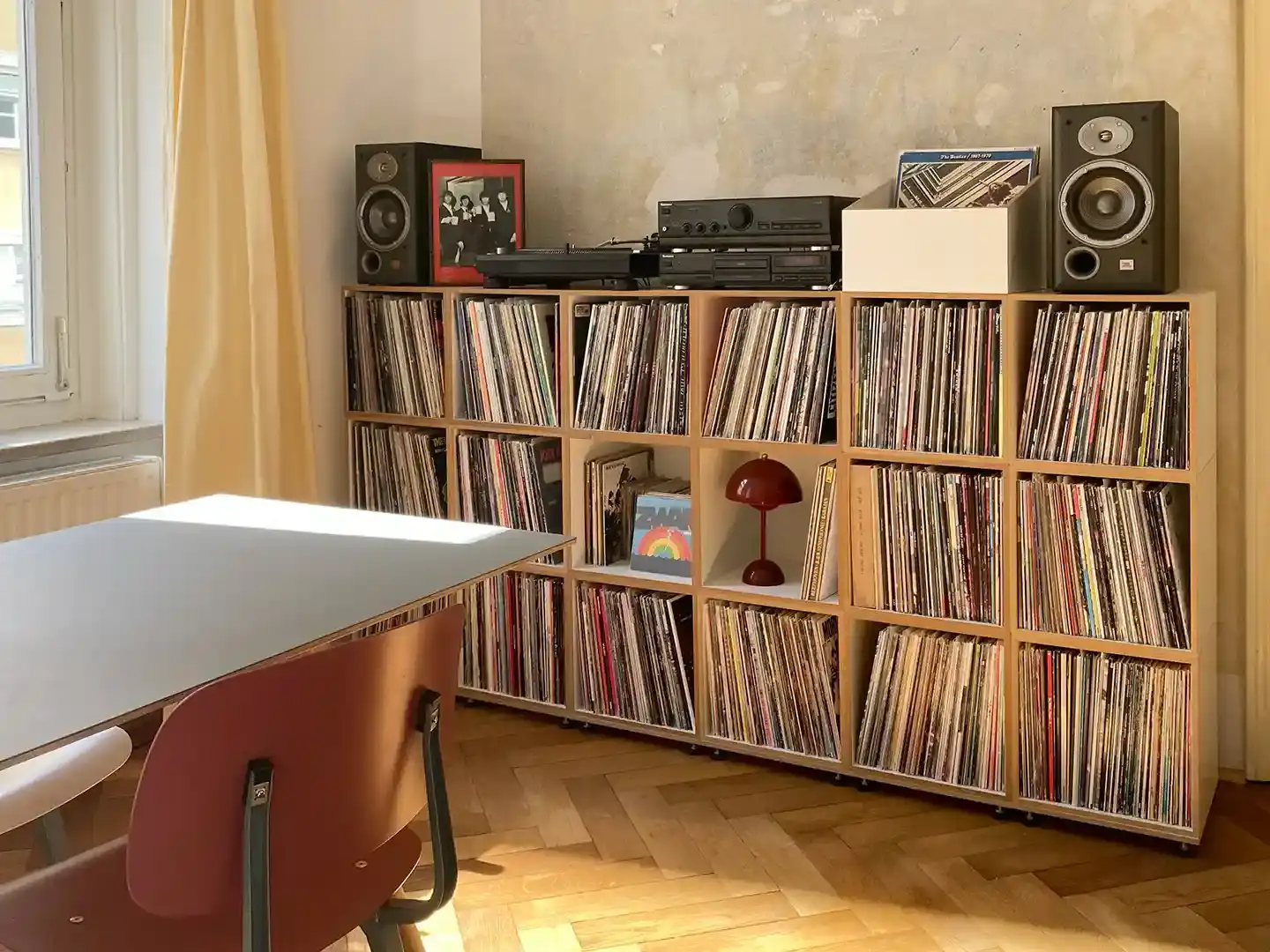
The answer can be summed up in three numbers: 30 centimeters of shelf depth is the technical minimum for an LP sleeve, 33 centimeters is considered a comfortable standard, and if you’re installing a back panel, you’re better off planning for a total depth of 35 centimeters right from the start. A 12-inch LP sleeve measures about 31.5 by 31.5 centimeters, while the record itself has a diameter of just over 30 centimeters. This explains why a shelf that’s 25 or 28 centimeters deep seems sufficient on paper, but in practice, the sleeve ends up tilted in the compartment or protrudes from the front.
When it comes to height, there’s one detail that many DIY shelves overlook: there should be a good centimeter of space above the edge of the sleeve. Without this clearance, you can’t grab a single record without pulling out half the neighboring row at the same time. 7-inch singles, measuring about 18 by 18 centimeters, are significantly more compact than LPs and therefore require less depth. In a traditional shelf, the compartment could be made narrower for this purpose; in a cube-based system, however, the depth is determined by the module, so only the width can be adjusted—for example, using a narrower 2:3-Cube .
Gatefold and box sets require more space: Double albums with gatefold covers (commonly called “gatefolds” ) and box sets are thicker than a standard case and take up additional depth. If you collect a lot of these, plan from the start using the upper guideline of 35 centimeters of shelf depth; this provides enough clearance at the back.
How heavy does a vinyl collection really get?
A full row of records weighs significantly more than the eye would suggest: according to one collector’s own calculations, 55 LPs together weigh about 15 kilograms. When the shelves are packed very tightly and filled to the brim, some collectors estimate that a single meter of shelving can even weigh 25 to 30 kilograms or more—an extreme value, not an average. As a rule of thumb, however, standard wooden shelves are designed to support only 10 to 20 kilograms per running meter of shelf space. A densely packed row of records can therefore easily exceed what the shelf is actually designed to support, which is precisely why collector forums regularly report sagging shelves, while no one has ever had a problem with the same shelf when it’s filled with books.
Why a full Cube is heavier than it looks: According to the data sheet, a 1:1 module holds 50 to 70 LPs. At about 270 grams per record, including the sleeve, that amounts to a load of 13.5 to just under 19 kilograms; for a standard-depth 1:1 module, the specified load capacity is a good 25 kilograms. So if you pack the Cube to the brim with standard records, you’re well within the safe range. A good guideline for shelf planning is therefore 45 to 50 records per compartment; this leaves room for additional records as well as a little space to make it easier to remove individual records.
This is especially true for wide, cantilevered shelves: A 2:1 module with a long shelf and no partition wall is rated by stocubo for only 7 kilograms, because a long shelf without a support in the middle sags more quickly than a compact 1:1 compartment. For vinyl records, this means in practice: it’s better to use several square modules stacked directly on top of each other; a single long shelf will sag under the weight more quickly than it appears.
7 Shelving Setups for Vinyl Collections Ranging from 100 to 900+ Records
The seven setups below are sorted by collection size, ranging from the first box of flea market finds to a full-fledged collector’s wall. All dimensions can be customized directly in the configurator using the stocubo overview for record shelves, in case your collection grows faster than expected.
Setup 1: 100 records in the corner of the living room
Two stacked 1:1 Cubes can hold about 100 to 140 LPs, depending on the thickness of the sleeves. Internal dimensions per compartment: 33.2 by 33.2 by 33 centimeters; when stacked, this results in a footprint of approximately 35 x 76 x 35 centimeters (W×H×D). This fits in a corner of the room or the space next to the sofa, and the top surface also supports the turntable.
As the collection grows, a third or fourth Cube can be added to the side, transforming the column into a small bookshelf in just a few simple steps.
Setup 2: A singles collection with about 400 tracks
Although 7-inch singles require less depth than LPs, the internal depth in the modular system remains 33 centimeters; only the height is reduced. According to the manufacturer, a 2:3 cube with internal dimensions of 33.2 x 21.3 x 33 centimeters (WxHxD) holds about 100 singles. Four of these arranged in a square (2 by 2) result in a footprint of about 35 × 66 by 35 centimeters and space for around 400 singles.
There’s a small area at the top for the turntable, which can be expanded with a hi-fi shelf; a 1:2 module with a drawer is sufficient for headphones and stylus accessories. If the collection expands to include LPs, the shelf can be expanded with 1:1 modules in just a few simple steps, while the rest of the shelf remains in place.
Setup 3: 300 LPs as a low sideboard
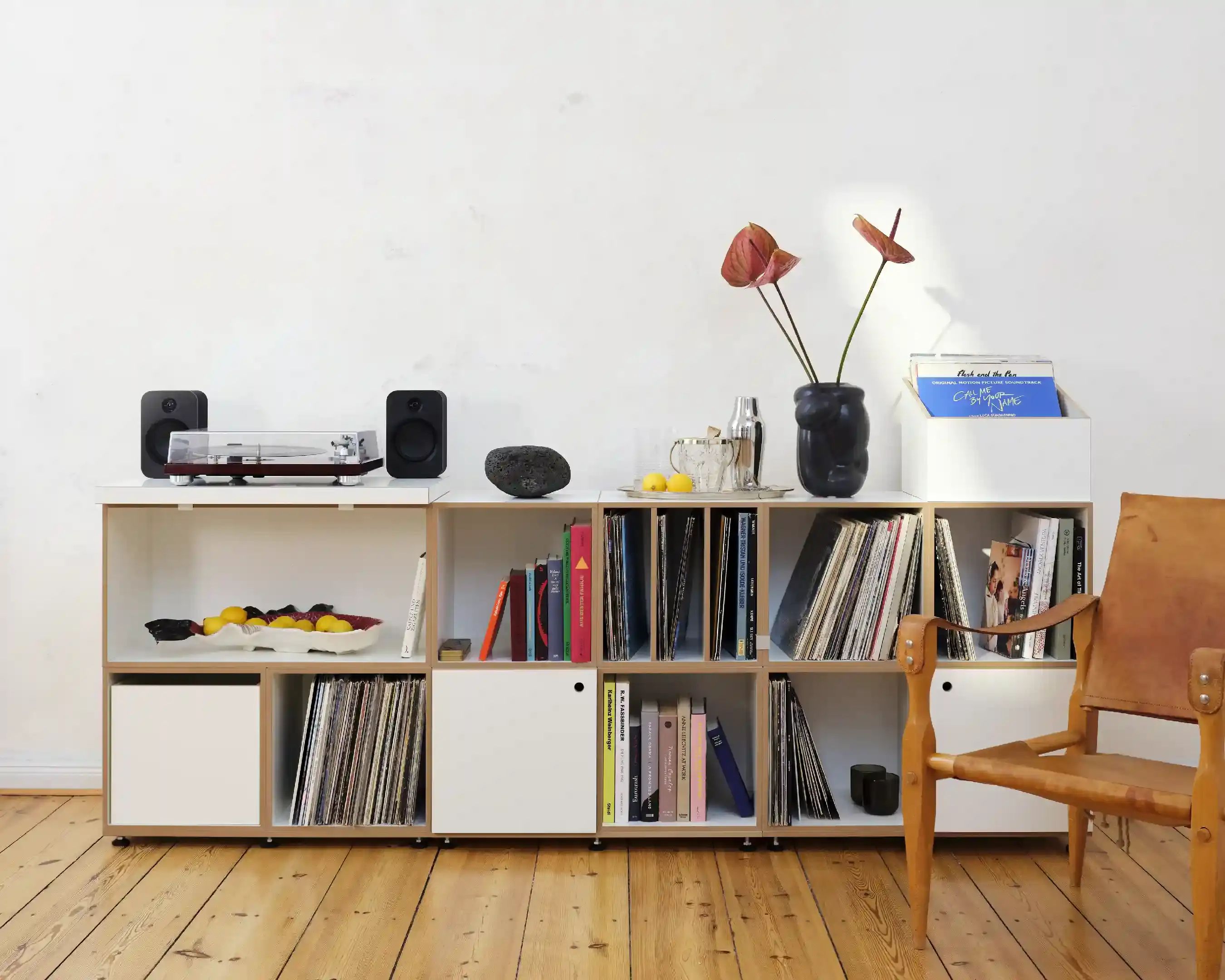
Six 1:1 cubes arranged in two rows of three modules each can hold a total of 300 to over 400 LPs, depending on the thickness of the sleeves. Dimensions: approximately 110 x 78 x 35 centimeters (W×H×D), low enough to serve as a sideboard behind the sofa or under a bookshelf.
The top provides space for a turntable and amplifier, while the sides offer room for one or two open shelves with decorative items. If your collection grows beyond 400 records, simply add another row of cubes on top—the height expands along with your collection.
Setup 4: 480 LPs plus a turntable and an amplifier
This setup is one of the real-life stocubo examples: 10 cubes plus an open flip-through box for browsing, with dimensions of 147 x 110 x 35 centimeters (W×H×D). In terms of capacity, this provides space for 480 LPs, plus a row at the bottom where you can quickly browse through your current selection without having to pull out a compartment every time.
At the top, there’s enough space for a turntable, amplifier, and a pair of headphones; the 35-centimeter depth can be extended to 40 cm with a matching hi-fi shelf. Additionally, there’s the option to add doors to the lower compartments.
Setup 5: 700 LPs in the style of a record store
Twelve Cubes plus two additional LPboxes bring the capacity to about 700 records; the special hi-fi module, with a depth of 40.6 centimeters and an extra-large cable outlet in the back panel, allows even larger amplifiers and turntables to be integrated into the shelf. Arranged in three rows of four Cubes each, the unit occupies a footprint of roughly 143 x 110 x 40.6 centimeters. If you prefer a taller setup, simply stack the same modules into four rows of three Cubes each.
The extra depth turns the shelf into a real workspace for mixers, headphones, and cables—almost like at a store counter.
Setup 6: The DJ Setup for Gigs and Home Use
Different standards apply for gigs than at home: small DJ cases hold 30 to 35 LPs, medium-sized ones 50 to 80, and large ones up to 100; a typical trolley used for traveling to the club usually carries around 50 to 60 records. At home, this role is filled by a permanent setup from which the next set can be quickly put together—without a case at all.
Two to three open flip-through boxes hold 100 to over 200 records and can be browsed while standing, almost like at the turntable right next to you. Space for four modules in two rows, topped by four 1:2 modules with drawers for headphones, cables, and other equipment: approximately 142 x 92 x 35 centimeters (W×H×D). For DJing at home, there’s still room next to it for a mixer and headphones; for a gig, the session selection goes into the case, and the rack stays behind, ready for the next time.
Setup 7: 900+ records as a collector's wall
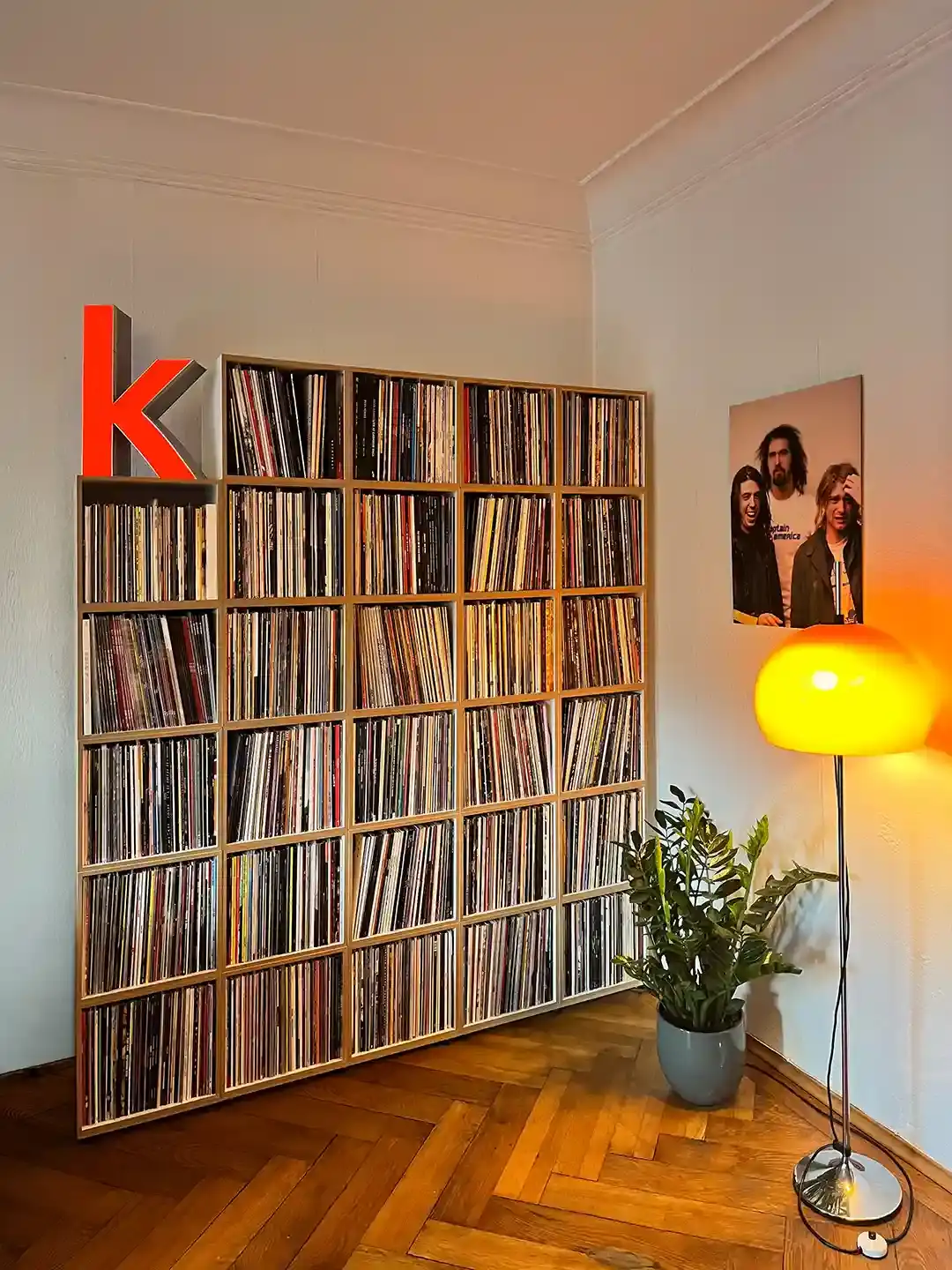
18 1:1 cubes provide space for about 900 panels. Arranged in six rows of three modules each, they form a wall measuring roughly 100 by 200 by 35 centimeters (W×H×D), though it can be wider or flatter depending on the chosen layout.
At what point does the weight of a vinyl wall become a problem? According to the 55-LP rule of thumb, 900 records weigh about 245 kilograms. Spread across 18 compartments, that averages out to a good 13 kilograms per Cube—notably closer to the limit than with the smaller setups mentioned above. With a shelf height of about 200 centimeters, wall mounting is therefore not a safety recommendation to be ignored, but is highly advisable; if there are small children in the household, this applies even at heights as low as 1.20 meters. Reports are also circulating in collector forums about bolted 25-compartment cube shelves holding 2,000 to 2,500 records without sagging, alongside discussions about when a ceiling reaches its limit when there are several thousand records in a room. For 900 plates, this isn’t an issue yet; only when the collection doubles again does structural integrity become a real concern.
A 900-series wall is rarely built all at once; it usually grows over the years, cube by cube. The process is the same for all seven setups shown above: In the stocubo configurator, you can take your time putting together the shelf to suit your own needs and dimensions and buy it right away.
Which shelf is best suited to your collection, wall, and listening habits?
Three questions are all it takes to narrow down your options. How many records do you actually have? How wide is the wall you have available? And are you more interested in casual listening or DJing? The answers will immediately show you which of the seven setups above is right for you.
| Criterion | Value | Appropriate Setup |
|---|---|---|
| Collection size | Up to 150 plates | Setup 1 or 2 |
| Collection size | 250 to 500 plates | Setup 3 or 4 |
| Collection size | 600 to 900+ plates | Setup 5 or 7 |
| Wall width | Narrow niche, less than 110 cm | Setup 1, 2, or 4 |
| Wall width | Full-length living room wall | Setup 3, 5, or 7 |
| Use | Listening, sideboard-style | Setup 3, 4, or 5 |
| Usage | DJ, at home and on the go | Setup 6 |
If you’d rather view the collection as a piece of living room furniture—rather than a traditional bookshelf—you’ll find options among thestocubo sideboards where individual shelf compartments can be hidden behind a closed front, and the record player sits on a smooth, uncluttered surface on top.
Listening vs. Storing: Closed doors protect the collection from dust and sunlight, but make listening to music a second or two more cumbersome because you have to wait for a door to open, and the door hinges on the side can get in the way when pulling out records. An open flip-through box is ideal for browsing, but it may collect a bit of dust as a result.
Checklist: What Matters When Building a Record Shelf
When assembling the shelf, six details determine whether it will be a nuisance in everyday life or simply work well—regardless of which of the seven setups you end up choosing.
- Wall mounting: Recommended for uneven floors at heights of 1.80 meters or higher; if you have children who like to climb, consider mounting as early as 1.20 meters shelf height.
- Base Plates & Feet: Always use the height-adjustable feet on the base plates to ensure that all Cubes stand level.
- Cable management: Use the hi-fi module for turntables and amplifiers on the shelf; thanks to the opening in the back panel, cables won’t hang across your field of view.
- Dust protection: Add-on doors protect album covers and vinyl from dust, especially in the less-used lower compartment.
- Children & Pets: Open compartments and drawers can act as climbing aids; if necessary, secure drawers with child locks.
- Connecting Clips: For LP shelves, always attach the clips from the back to protect the album covers inside the compartment.
Buying Cubes is just the beginning: Doors, drawers, and individual modules can be reordered at any time without having to take the existing shelving unit apart. Most often, doors for the lower, dust-prone compartments and small drawers for cleaning brushes or spare needles end up being added to the shopping cart later on. Ultimately, Cubes is simply a system that can be expanded and rearranged as your collection grows and with every new apartment.
From the first cube to the finished vinyl wall
The biggest mistake people make when designing a record shelf is rarely the depth. More often than not, it’s the unspoken assumption that the collection will stay as large as it is today for a long time—which, in practice, is almost never the case. If you build according to the dimensions listed above, you’ll end up with a shelf that grows with your collection and will still fit even in two or three years.
The pragmatic approach: start with one of the seven setups listed above and measure your actual collection carefully beforehand. When making a purchase, it’s worth picking up one or two extra Cubes right away—for your next flea market find or a birthday gift. That way, you won’t suddenly find yourself with a shelf that’s too small again. Nothing is set in stone, though; a modular shelving system can be expanded and rearranged at any time.