

The stocubo changing table top always measures 74 x 80 cm, but its height can be adjusted to match that of the Cube base underneath, typically between 85 and 94 cm. The surface area remains constant; the height can be adjusted by choosing the appropriate row of modules underneath. Two setups below show how this fixed surface can be integrated into a niche and a laundry area, each with the number of cubes, compartment layout, and conversion plan for a sideboard.
Ready-made changing tables from furniture stores come in exactly one width and one depth, and if the space doesn’t fit, the only option is usually to improvise with rolled-up towels as makeshift edges. With stocubo, the changing surface is also fixed at 74 x 80 cm, but the base underneath can be adjusted modularly in height: choosing the right modules for each layer brings the changing surface to the appropriate height for shorter or taller parents. Once the child has outgrown the diaper-changing stage or has simply become too active for standing-height diaper changes, the top unit can be easily removed, and the two rows of cubes in the changing table can be reconfigured into a single row to serve as a sideboard.
If you know in advance how many cubes go where, you won't have to make adjustments later.
- The comfortable changing height ranges from 85 to 105 cm, depending on the parents’ height.
- Two setups show how the fixed 74 x 80 cm changing surface can be combined in the standard niche and with a laundry area.
- Safety guidelines recommend side rails at least 20 cm high, a requirement that some changing tables on the market do not meet.
- Once the diaper-changing phase is over, the two rows of Cubes can be converted into a single row of a sideboard in just a few simple steps.
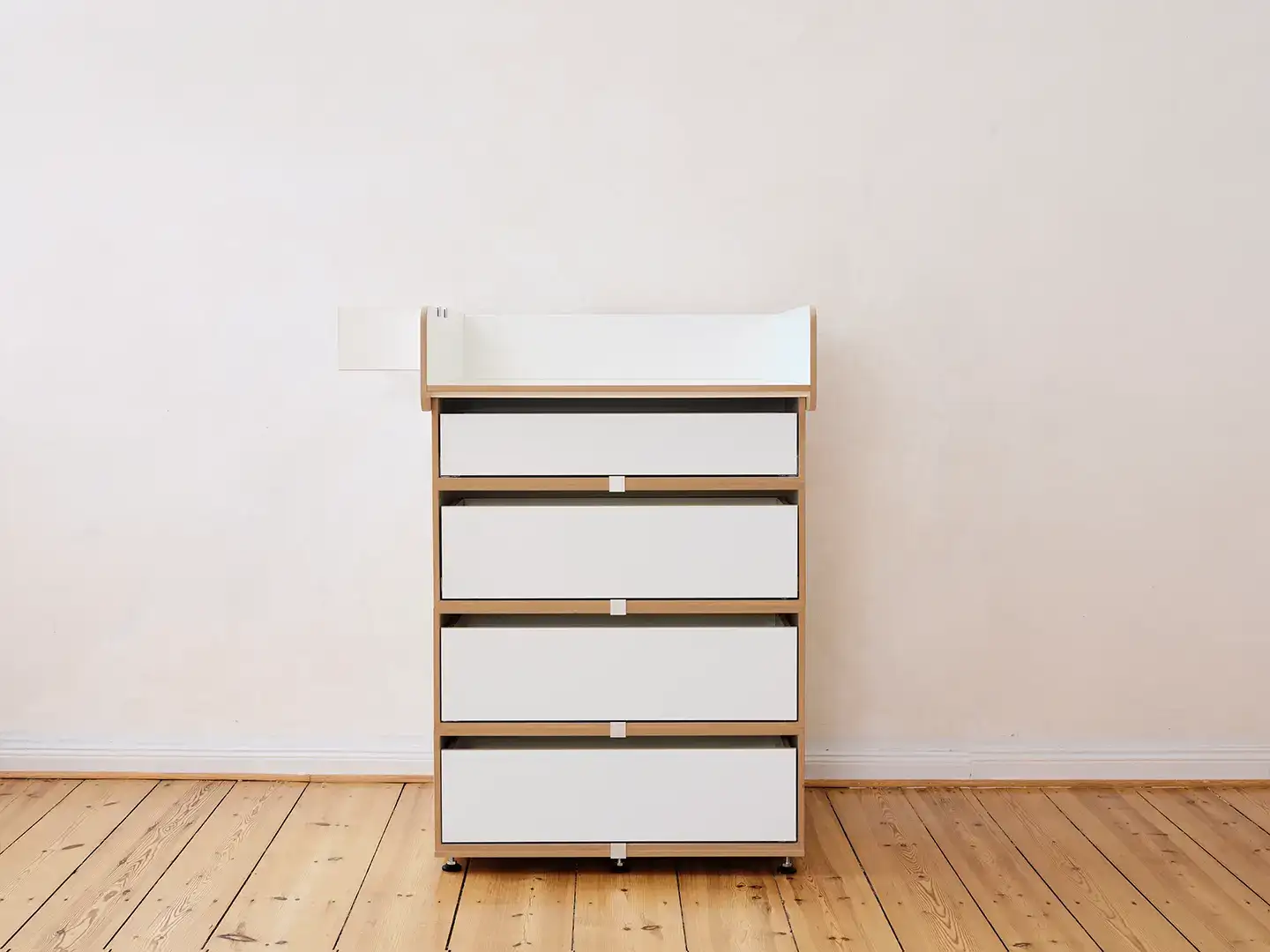
What are the actual dimensions of a changing table?
The changing table height follows a simple rule of thumb: elbow height while standing minus 10 to 15 cm, because if you have to bend over too far, you’re not doing yourself, or your back, any favors in the long run (Limmaland Changing Table Guide). In practice, this means: about 85 cm for parents who are around 1.60 m tall, and 95 to 105 cm for those who are about 1.70 m or taller. With the stocubo changing table, you can adjust this exact measurement: The surface area of the top unit always remains at 74 x 80 cm; only the front row of the cube base underneath expands or contracts, bringing the changing height to approximately 85 to 94 cm depending on the selected modules.
What does DIN EN 12221 cover? The standard specifies the safety requirements for winding units intended for household use, applicable to children weighing up to 15 kg. Tip-over stability and rounded edges are mandatory requirements under this standard. (DIN EN 12221-1:2013).
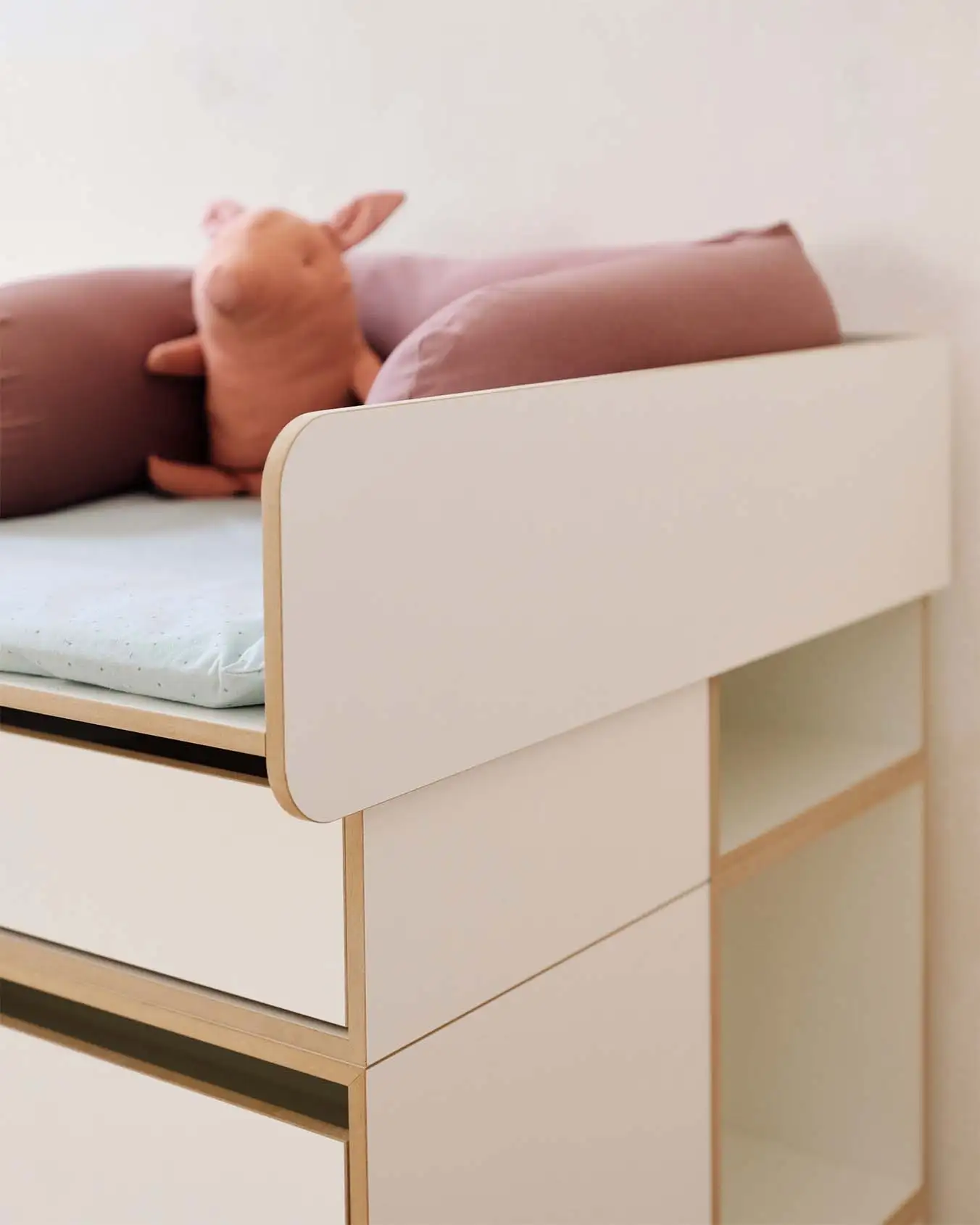
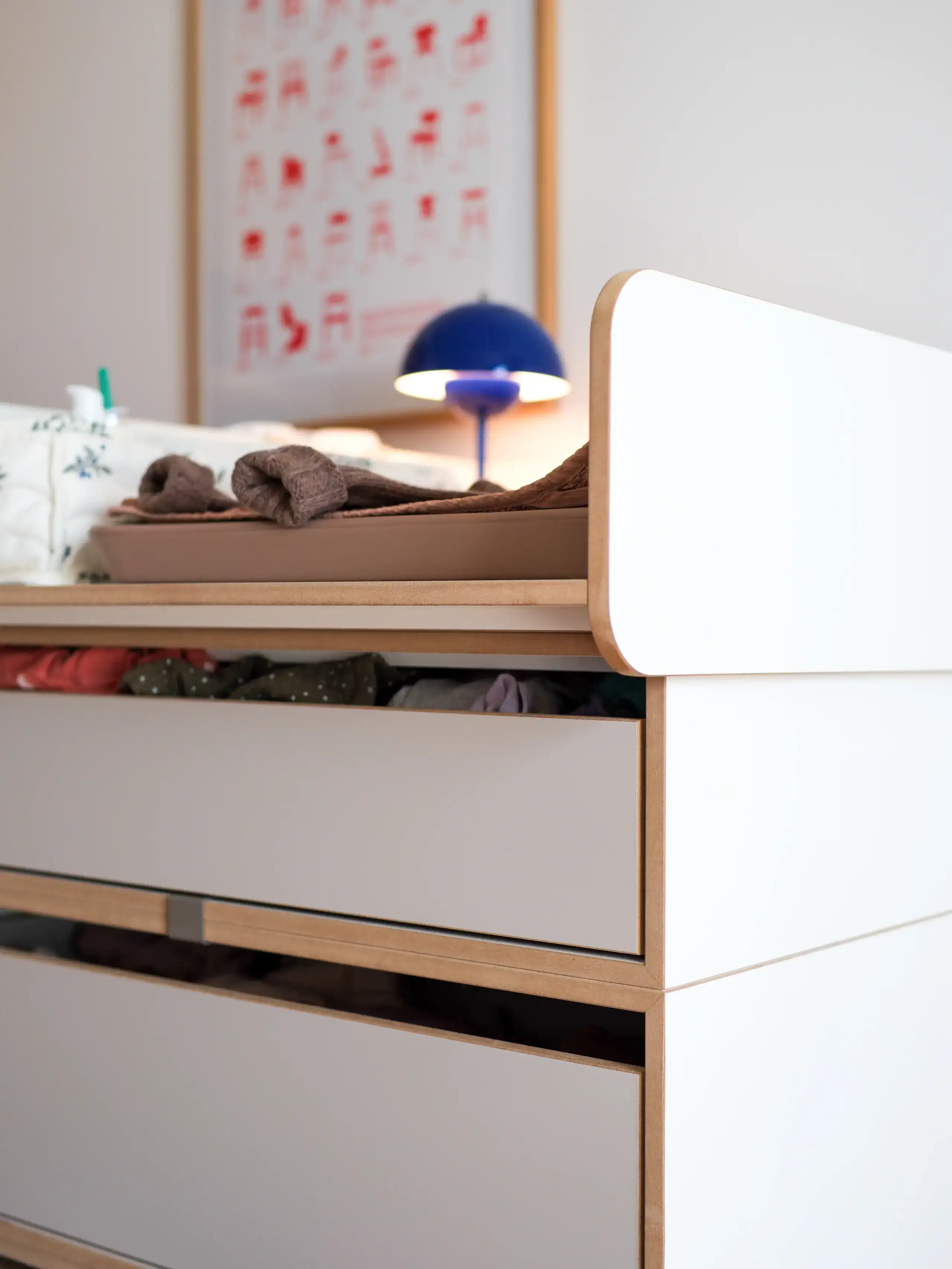
When it comes to surface area, the guidelines are more specific. Independent safety sources recommend a minimum of 55 x 70 cm, preferably 70 x 80 cm, with padded side barriers at least 20 cm high to prevent falls (BZgA Guide to Changing Tables). The stocubo changing panel, measuring 74 x 80 cm, offers plenty of space; however, its side rails, at just under 15 cm, are slightly below the recommended minimum height of 20 cm.
Good to know: A margin of just under 15 cm is no reason to panic. The most important thing is this: Never take your hand off the child, no matter how close the wet wipe package may seem, and if you want extra safety, place a non-slip mat on the surface and keep an eye on the safety belt.
For the cube calculation, a single basic measurement is sufficient: A 1:1 cube measures 35.6 x 35.6 x 35.6 cm on the outside, leaving 33.2 x 33.2 x 33 cm of storage space on the inside. From this, both setups shown below can be directly derived, including front-row height and compartment allocation.
Which changing table setups can be put together right away with stocubo?
The two setups below show the dimensions, the number of cubes needed, and a diagram of what the setup will look like after changing time. Both use the same basic configuration: two rows of cubes under the changing table, one visible row in front and a second row behind it. The height can be adjusted as usual with the modular stocubo system, depending on which cubes are added or removed:
- 1:1 cube: 35.6 cm edge length.
- 1:2 module, double width: 17.8 cm high by 71.2 cm wide.
- 2:3 module, double width: 23.7 cm high by 71.2 cm wide.
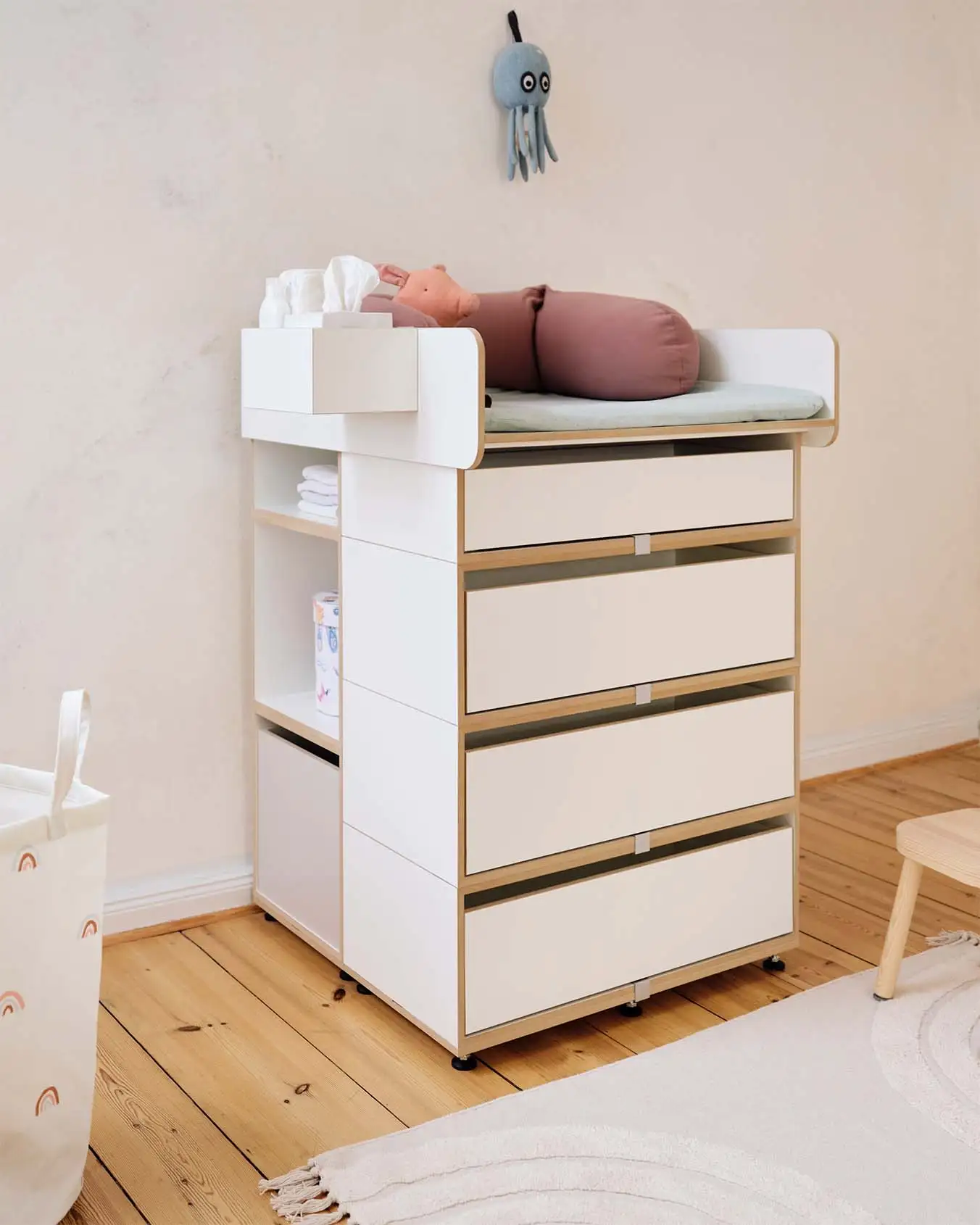
Setup 1: The Basic Shape for the Standard Niche
The basic design of the stocubo changing table always consists of two rows of cubes beneath the changing top: a visible front row and a second row at the back, both of which fit beneath the 80-cm-deep top. The height can be adjusted as is customary with the modular stocubo system, depending on which cubes are added or removed.
With the large dresser as the front row (W 71.2 x D 35.6 x H 92.4 cm, four drawers), the total dimensions including the changing table top are H 108.4 x W 73.9 x D 80 cm, resulting in a changing height of about 94 cm – comfortable for most adults. If you need a more compact setup, swap out the front row for three stacked 2:3 double-width modules (total height 71.2 cm) to achieve a height of about 85 cm – practical for parents around 1.60 m tall. The changing surface remains exactly the same in both cases; only the row below grows or shrinks.
- Front row as the base: a large dresser or three 2:3 double-width modules, depending on the desired height.
- Changing table at the front: 749 x 80 cm surface area with a 15 cm edge.
- Four 1:1 cubes at the back: two of them equipped with pull-out drawers.
- Optionally, two 1:2 modules at the back: for flat, rarely used items.
- One hanging cube: for diapers and care supplies, without taking up additional floor space.
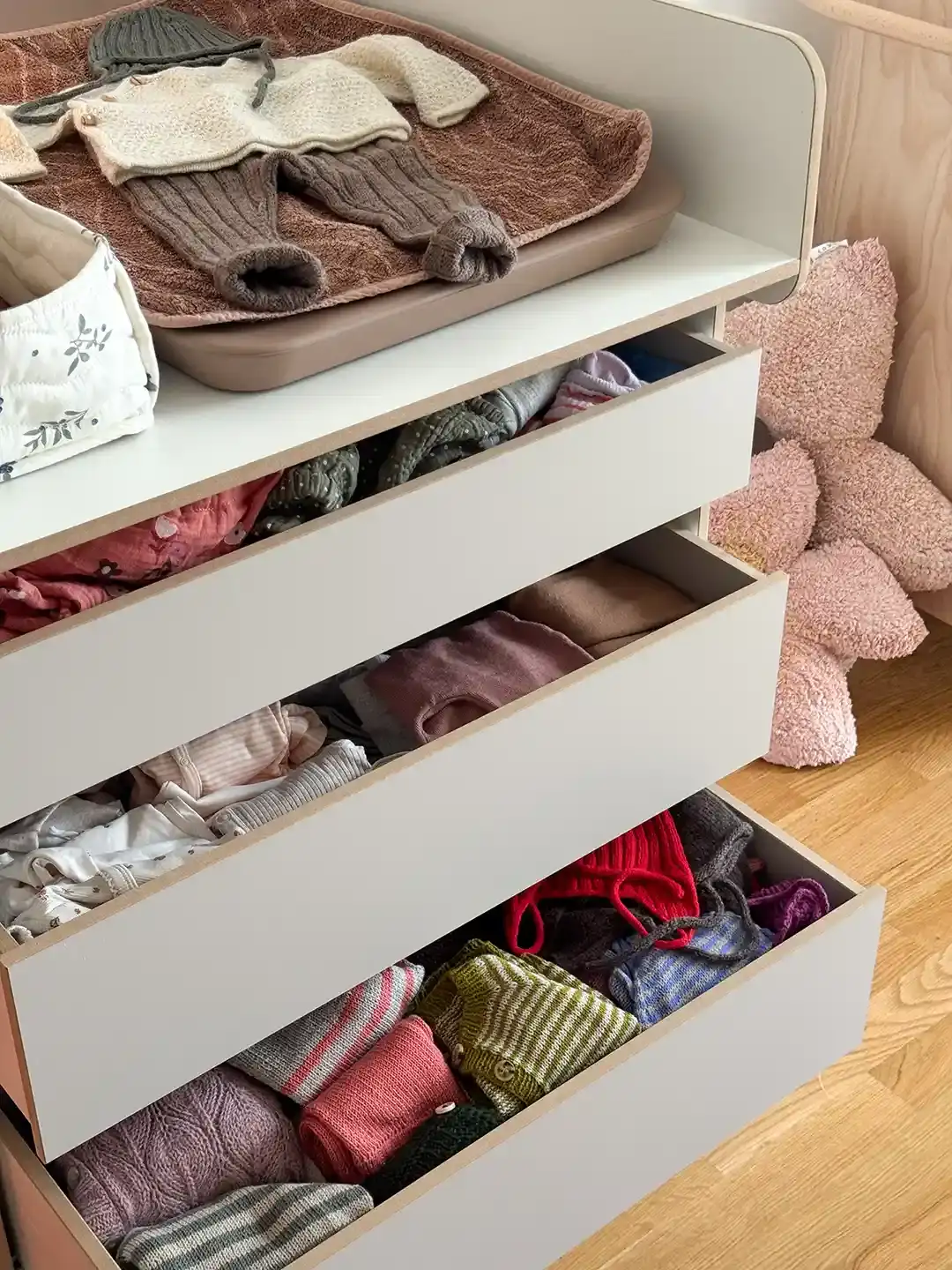
The four drawers in the front row can be arranged according to how often they are accessed; the inserts and 1:2 modules take care of the rest:
- Top: Wet wipes and cream, because those end up in your hands most often.
- Second drawer: A stack of diapers for daily use.
- Third drawer: Bodysuits and onesies.
- Bottom: Towels and spare sheets, along with sleeping bags and play mats, which stay there even after diaper-changing time.
- Back compartments: Bulk packs of diapers.
- 1:2 modules on the sides: flat items like burp cloths or spare changing pads.
If the top section is removed later, the stocubo changing table doesn’t simply remain unchanged: the front and back rows can be rearranged into a single, continuous row – the classic stocubo sideboard configuration. Since the items that are meant to stay put are already stored at the bottom from the start, only the upper half of the front row needs to be rearranged during the conversion. Four drawers in the front and four cubes in the back thus become a single, long sideboard, without the need for a new piece of furniture.
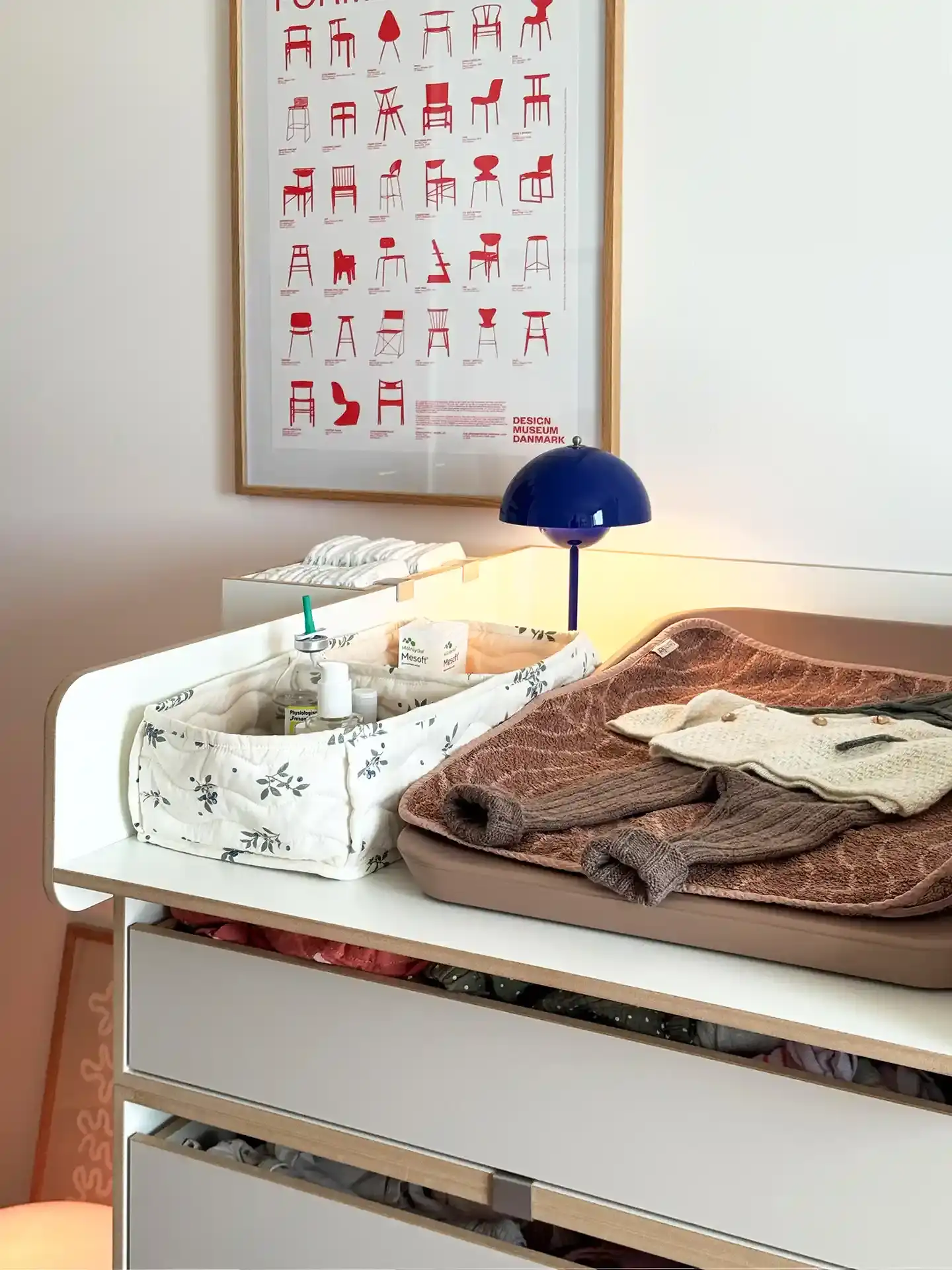
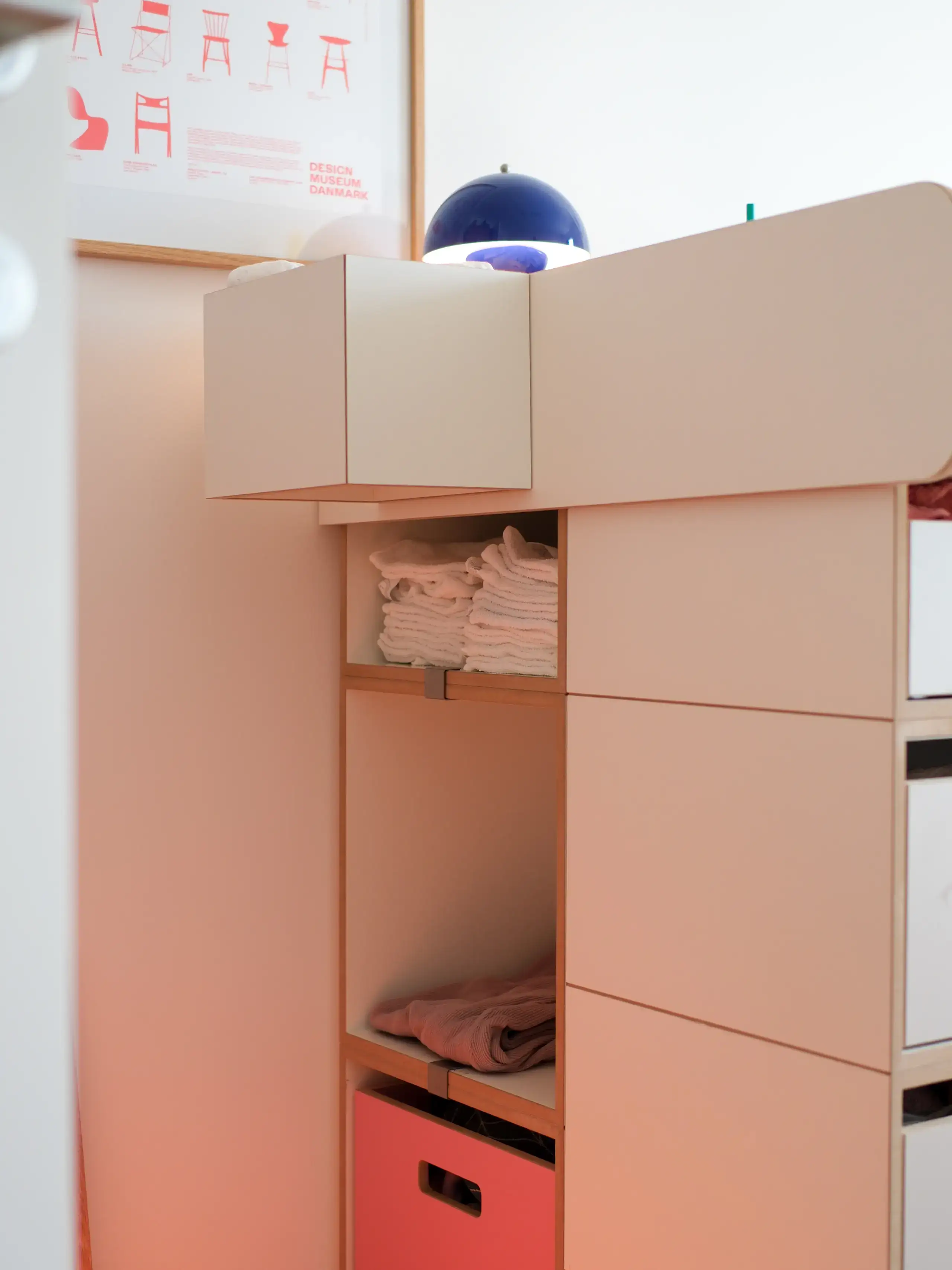
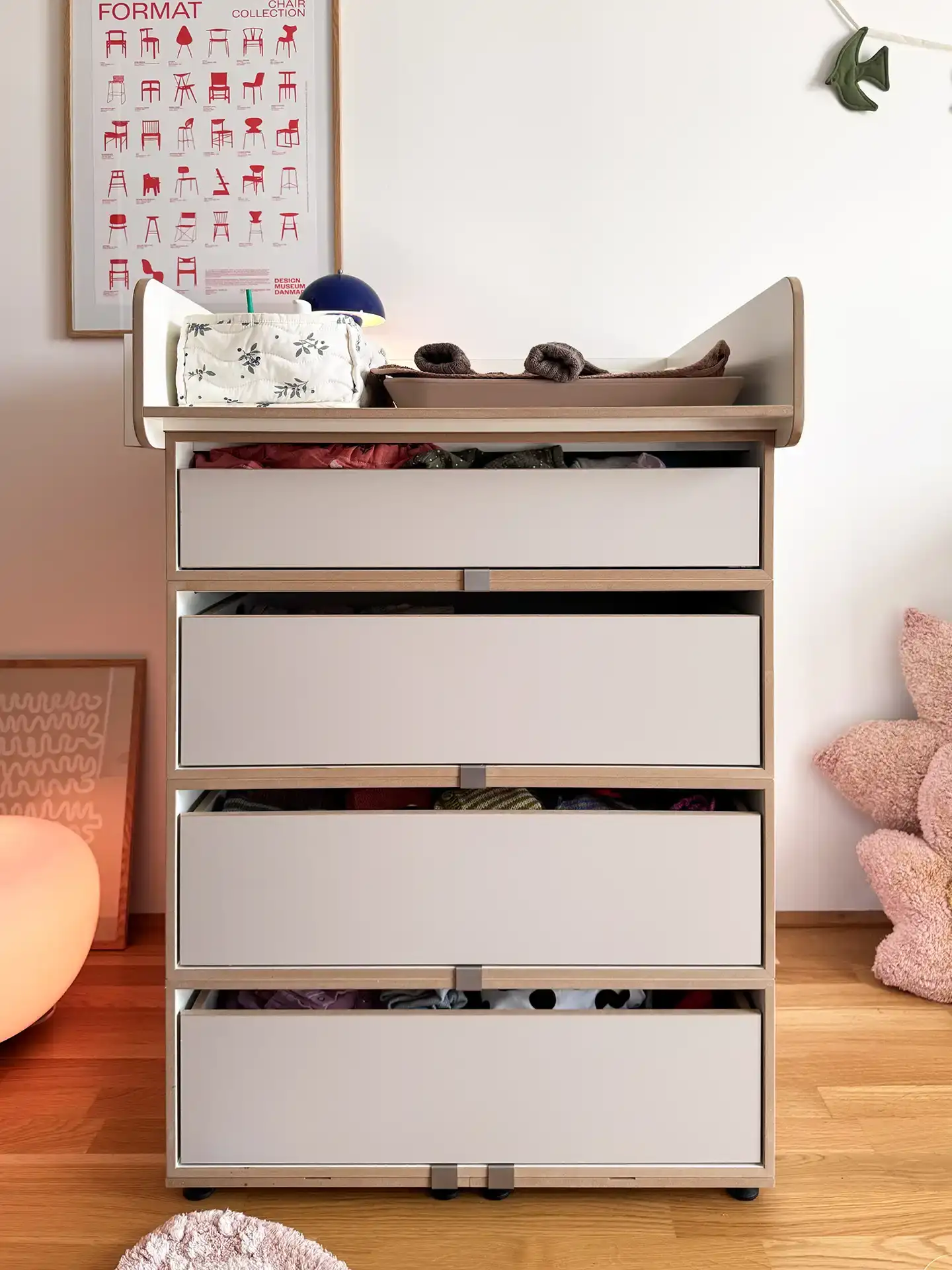
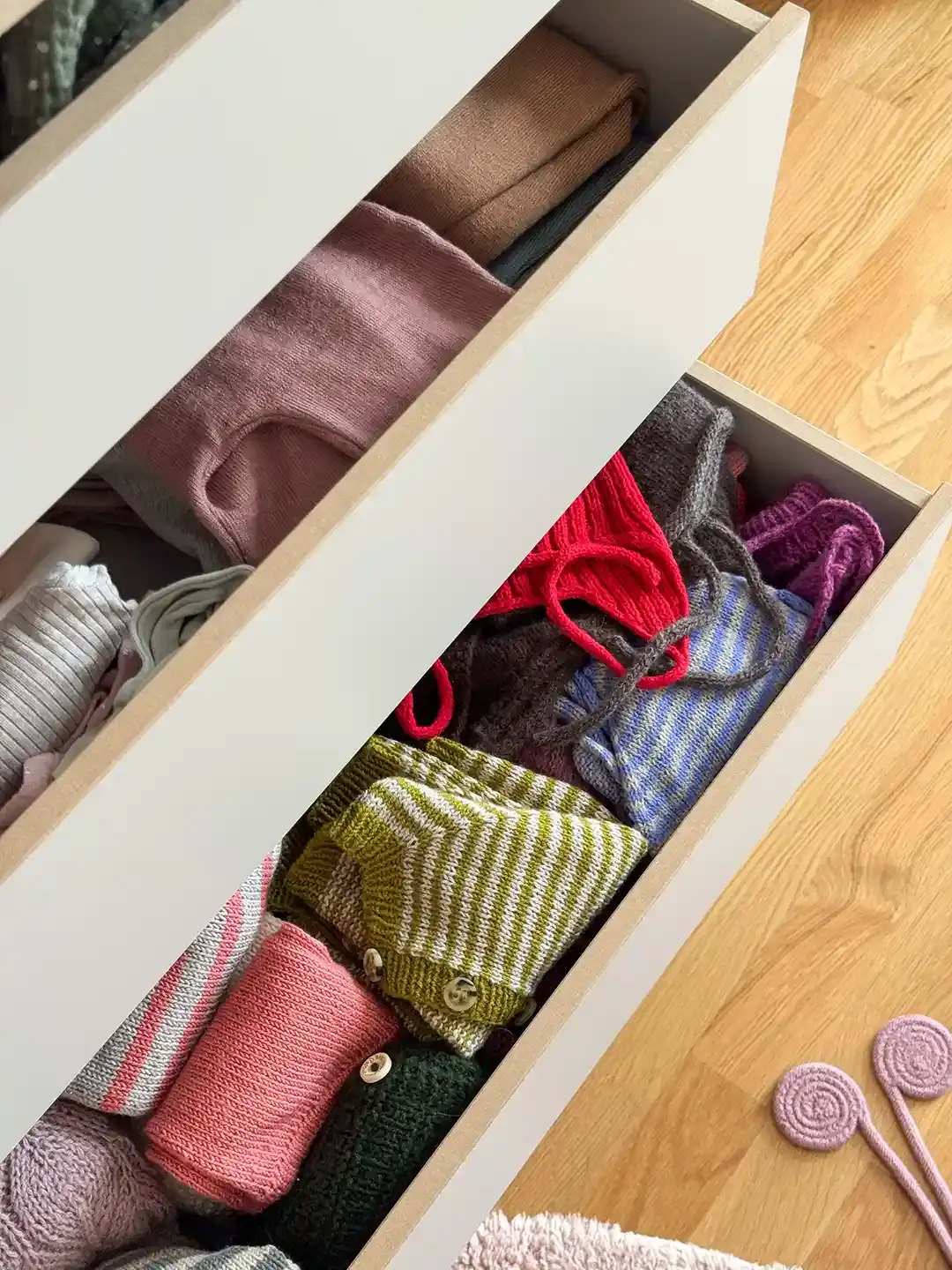
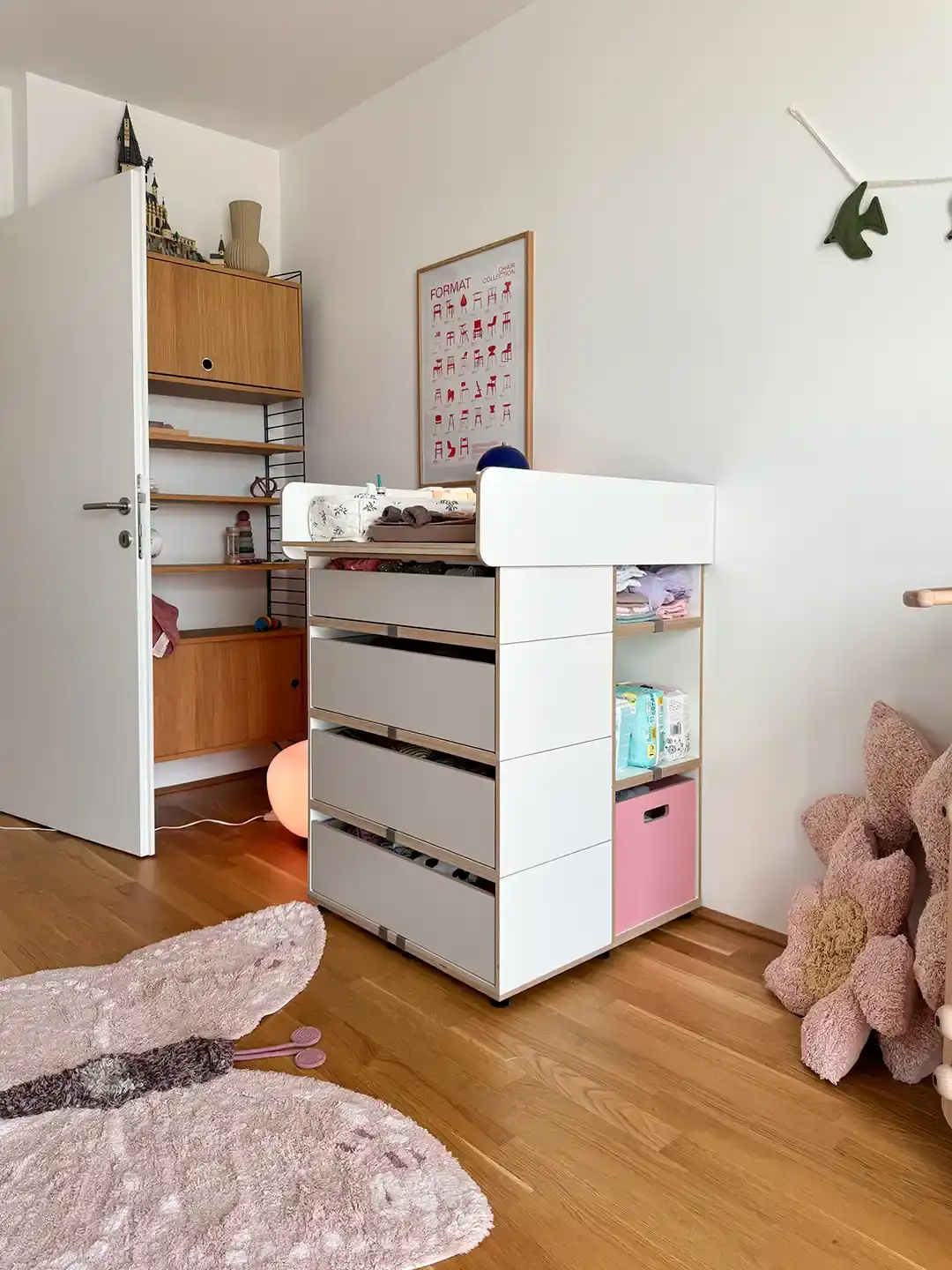
Setup 2: Diaper changing and laundry in one step
If you want to put away dirty laundry right after changing a diaper, you don’t need a second set of cabinets – just an open niche right next to the dresser. In addition to the standard configuration from Setup 1 (W 74 x D 80 cm), there’s a cube-free space about 45 cm wide and two rows high (D 35.6 x H 71.2 cm) available for a laundry basket.
Laundry baskets for one to two people are typically 30 to 45 cm wide and have a capacity of 40 to 60 liters; family households tend to opt for baskets with a capacity of 60 to 90 liters and a width of about 45 to 50 cm (Dawelba Laundry Basket Guide). A 45-cm-wide niche without a partition can accommodate both sizes; combined, this setup totals about 119 cm in width.
The changing compartments remain the same as in Setup 1; the niche holds burp cloths and used onesies, which can be tossed directly into the basket with one hand while the other hand stays with the baby. Once diaper-changing time is over, the laundry basket niche simply remains what it always was; only the dresser section becomes a single-row sideboard version, as described in Setup 1.
Safety Checks That Matter for Every Changing Table
For changing tables designed for infants weighing up to 15 kg, tip-over protection is actually required by standard; DIN EN 12221 explicitly mandates it. The higher the front row is configured, for example, using the large dresser instead of the more compact modular version, the more important it becomes to have an additional wall mount in addition to simply clipping the modules together.
In everyday use, edges and handles often matter more than the big picture. The DIN standard requires rounded edges, and the stocubo inserts feature no protruding metal handles. Instead, they have handle recesses on both sides that prevent fingers or a baby’s head from bumping into them. It is precisely these recesses that allow the drawer to be operated with just one hand, while the other hand stays with the child – and that matters more than any other detail at the changing table.
Historical Context: Older tests by ÖKO-TEST and Stiftung Warentest repeatedly found that the changing tables they tested had drop-protection edges that were too low and emitted formaldehyde from inexpensive materials (ÖKO-TEST, 2009/2010). While the tests themselves are outdated, the underlying issue remains relevant: It’s still worth checking for low-toxicity materials and generous overhangs when making a purchase.
When it comes to cleaning, a smooth, coated finish, such as the white-coated MDF used in the Cubes, pays off: Wiping it down with a damp cloth is usually enough, without the need for any special cleaners. If you use a nightlight or radiant heater near the changing table, you should maintain the distance from the radiant heater to the child specified by the manufacturer and avoid mounting a shelf directly above the changing table (Product Guide from the Federal Working Group for Greater Child Safety).
Which add-ons make the stocubo changing table more practical for everyday use?
Open cubes look tidy in the configurator, but in real life, with diaper packs and burp cloths, they quickly fill up with things you’d rather not show. Doors and drawers bring order to exactly those areas without having to move a single cube. They’re simply added in front of or inside the existing modules.
Color accents can also be added later, rather than having to make a decision for the next few years right at the time of purchase. If you start out with a more subdued look in the nursery and later, when the changing table becomes a sideboard, want a bolder front color, you simply swap out the fronts, not the entire piece of furniture.
Even as needs grow, whether due to a second child or simply more supplies, you can add on rather than replace the furniture: additional 1:1 or 1:2 cubes can be attached to the existing stocubo changing table. If you use one of the two setups above as a starting point, you can recreate it exactly in stocubo configurator and adjust the height of the front row to fit your own space.
From changing table to sideboard: Why the cube concept pays off
The real difference between a store-bought changing table and a custom-designed one only becomes apparent after the diaper-changing years are over. While a built-in piece of furniture usually ends up in the basement or as bulky trash, with stocubo all the modules stay in place – only the arrangement changes: the two rows under the top unit become a single continuous row that serves as a sideboard.
Anyone who sorts the drawers of Setup 1 into “stays” and “goes” from the start, storing spare bed linen and play blankets in the bottom drawers and nappies and wet wipes in the top drawers, avoids having to reorganise everything when converting the unit. This is because only the upper half of the front row of drawers needs to be rearranged. The conversion itself does not require a workshop – just a quiet afternoon.
In the end, the choice is simple: combine the fixed top unit with the matching front row height from Setup 1, add the laundry basket niche from Setup 2 if needed, and put the combination together in the configurator long before the baby even arrives. Later on, the same combination can be turned into a sideboard for the living room or hallway – without needing any new furniture at all.
Changing Table: Frequently asked questions
What is the maximum depth for a changing table in a small bathroom?
It should be less than 40 cm deep; otherwise, it will quickly become cramped in a small bathroom or hallway. Cubes with a depth of 35.6 cm fit perfectly within this range and still leave room for the door to open.
Is a 15-cm side edge sufficient for a changing table attachment?
Safety guidelines recommend padded side rails at least 20 cm high, while standard changing pads, such as those from stocubo, are 15 cm high. This difference can be compensated for by keeping one hand on the child at all times while changing them and by avoiding the use of slippery surfaces.
What is the ideal changing height when two parents are different heights?
A height between 88 and 95 cm is usually the most practical compromise when both parents are significantly different in height. This range is derived from the average of the two individual ideal heights, calculated using the formula “elbow height minus 10 to 15 cm,” and it is close to the 94-cm-tall front-row model with the large changing table.
Can a changing table be placed directly under a radiant heater?
Placing it directly underneath is only safe if the manufacturer’s specified safety distance from the child is maintained and there are no cables hanging down freely. Additionally, no shelf or compartment should be mounted directly above the changing area to avoid both the risk of bumping into it and cable tangles.
What happens to the changing table once the child is past the diaper-changing stage?
The DIN EN 12221 standard sets the weight limit at 15 kg; once that limit is reached, the changing pad is no longer needed anyway. With the stocubo changing table, all it takes at that point is a quick adjustment to the changing pad plus rearranging the two rows of cubes into a single row—and the changing table becomes a sideboard.